
Tracing the USSR
By Paras Jariwala

Dr. Paras Jariwala is a physician currently working in the north west of England. He stands for materialist science and philosophy, a planned economy, labour-time calculation, and direct democracy. In his debut piece for Cyclone, Paras looks back at the battle for communism in the world’s first workers’ state, and explores the potential economic and democratic models of future socialist projects.
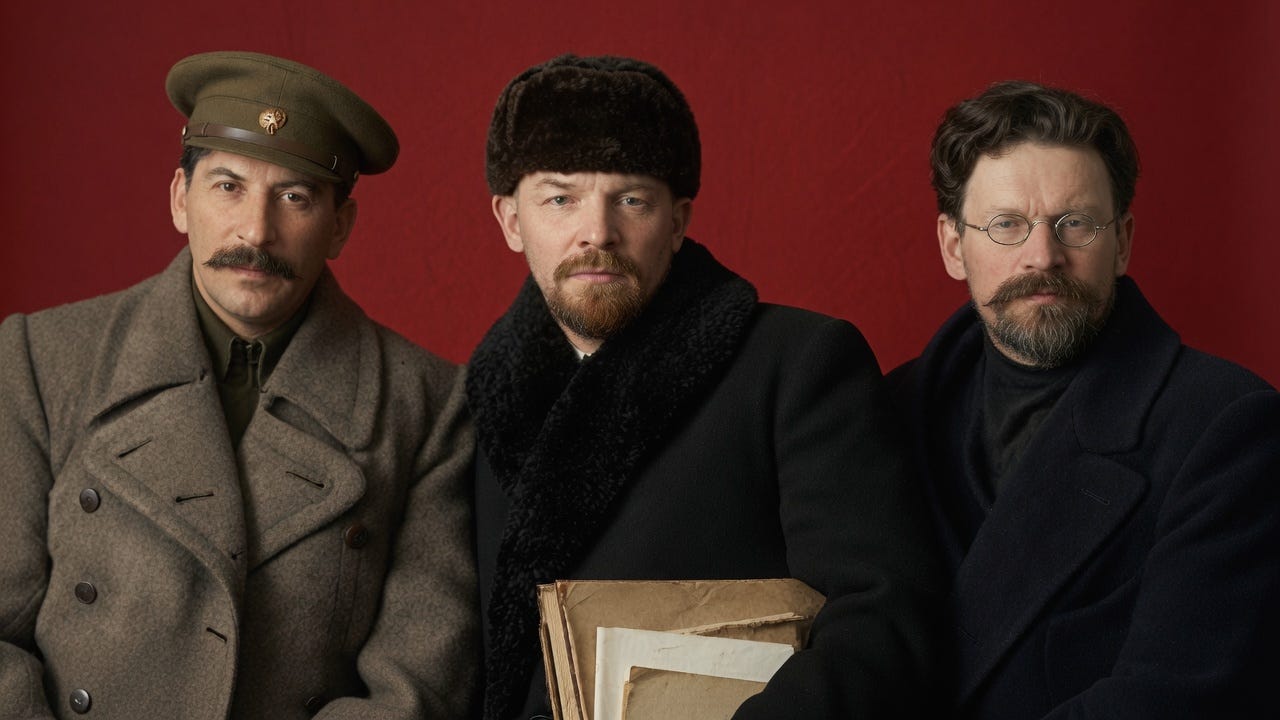
There is perhaps, no greater social achievement thus far, than by Lenin, Stalin, and the Russian working class in building the first workers’ state in the former USSR:
The creation of the first planned economy, the first society founded on the basis of social equivalence, and the rejection and breakdown of class structures and hierarchy.
The unprecedented growth in wealth, industry, and agricultural production brought about by direct communist government that supported the workers’ interest.
The revolutionary transformation towards a new socialist mode of production and the defeat of the great colonial and continental empires of old Europe through the socialist challenge.
The grounds of the theoretical distinction between communism and socialism can be described as that of scientific materialism and utopianism, between revolution and reformism, between social kinship and community, and social strata and the state.
There are two considerations that forced the USSR into the position of reinforcing a constitutional order that did not allow the mass of the workers direct control over planning, and instead subordinated them to the national employers:
The retention of the wage-economy and commodity production
The reliance on elected politicians that constituted a form of aristocracy
From the standpoint of the Bolsheviks in 1917, there is no doubt that a regulated wage-economy, and a form of government that utilised elections represented a radical departure from what existed previously. The state under the Tsar, the interests of the imperialists and rentiers, and the widespread backwardness encouraged by the landowners created conditions that would precipitate an enormous crisis, and only a group of committed insurrectionists guided by a correct theory could solve such a crisis.
The wage-economy would have offered continuity with contemporary accounting practices, and would have offered a way to encourage urban migration and the direction of labour into state-owned industries that were now the focus of the communist governments as they gave direction to enterprise for production. The critical advances were to ban maleficent practices such as child labour and unpaid overtime. The mass of the peasantry could also be brought closer to the worker, in this sense, through an economic class alliance and their integration into the wage economy. These practical sensibilities were combined with an implicit loyalty to Bolshevik party programmes and Kautsky’s proclamations about the wage economy being fundamental to the future of socialism, since Kautsky believed money to be the only practicable way of measuring value, and that the existence of value is dependent upon relations of exchange.
“I speak here of the wages of labor. What, it will be said, will there be wages in the new society? Shall we not have abolished wage labor and money? How then can one speak of the wages of labor? These objections would be sound if the social revolution proposed to immediately abolish money. I maintain that this would be impossible. Money is the simplest means known up to the present time which makes it possible in as complicated a mechanism as that of the modern productive process, with its tremendous far-reaching division of labor, to secure the circulation of products and their distribution to the individual members of society. It is the means which makes it possible for each one to satisfy his necessities according to his individual inclination (to be sure within the bounds of his economic power). As a means to such circulation money will be found indispensable until something better is discovered. To be sure many of its functions, especially that of the measure of value, will disappear, at least in internal commerce. A few remarks concerning value will not be out of place here since they relate to what will be of much importance in our future discussion.
There could be no greater error than to consider that one of the tasks of a socialist society is to see that the law of value is brought into perfect operation and that only equivalent values are exchanged. The law of values is rather a law peculiar to a society for production for exchange.”
[Kautsky, 1903]
It must be remembered that for the longest time, Russian Social Democracy was tied to German and European socialist internationalism, and it was only towards 1917 that a split occurred. This was due to political reasons related to the parliamentary road, war, and imperialism, not for economic or theoretical reasons of monetary versus labour-time calculations. The Bolsheviks supported a wages system, and advocated the regular enforcement of money wages.
“Payment of wages in kind to be prohibited; regular weekly pay-days to be fixed in all labour contracts without exception and wages to be paid in cash and during working hours.”
[Lenin, 1964]
Through the success of the Bolsheviks, this continued into the Second Congress of the Communist International. If one looks at the Theses on the Conditions of Admission to the Communist International, the political polemic against Kautskyist social democracy is clear, but nowhere do they affirm that parties wishing to call themselves “communist” must support the abolition of the wages system, despite this having been an explicit demand of Marx, and even of the trade unions.
At the same time, and quite apart from the general servitude involved in the wages system, the working class ought not to exaggerate to themselves the ultimate working of these everyday struggles. They ought not to forget that they are fighting with effects, but not with the causes of those effects; that they are retarding the downward movement, but not changing its direction; that they are applying palliatives, not curing the malady. They ought, therefore, not to be exclusively absorbed in these unavoidable guerilla fights incessantly springing up from the never ceasing encroachments of capital or changes of the market. They ought to understand that, with all the miseries it imposes upon them, the present system simultaneously engenders the material conditions and the social forms necessary for an economical reconstruction of society. Instead of the conservative motto: “A fair day’s wage for a fair day’s work!” they ought to inscribe on their banner the revolutionary watchword: “Abolition of the wages system!”
[Marx, 1969]
This is because wage employment is a capitalist relation of production that directly subordinates people to capital via a contract, and thus a portion of their time is obligated to the employer, whether this capital is in private or national hands. Thus, exploitation necessarily occurs as money wages are set below the value actually created in order for firms to account for the value product they appropriate as surplus, as part of the sales revenue. This enforces profit calculations and market relations. Wages can never account for work done, and via commodity production will, on average, represent the cost price of reproducing labour-power across the workforce, the ability to work. Random variations in money payments and purchases will create income inequalities between individuals that are not equivalent to their work time contributions, and due to occupation or status will then create systematic inequalities between sets of workers (males versus females, graduates versus non-graduates, etc.) So long as a wages system and a commodity form of production exists, humans cannot escape domination by firms, they cannot escape rule by their employers, and workers will be commanded by those that have money, whether an appropriating class, an appropriating firm or bank, or the appropriating state. This exploitative relationship can only end once the wages system has been abolished.
The issue over government, however, became how to command the military units and rural elements tied to localities in order to consolidate rule for the defense of the revolution. In this, so-called democratic centralism offered the solution. In Aristotle, we see how he describes forms of government in which rural delegations are made by the husbandmen who serve in assembly as a form of democracy [Aristotle, 1885]. As a peasant country has poor transport and road infrastructure, peasants are bound to seasonal harvest and direct work on the land and household domestic labour, necessitating the delegation of educated men to represent them. This occurs alongside a key political-class dependency relationship, which is the republican reliance on recruitment via peasant militia for service in the army, which would have been critical during the Russian Civil War.
Thus the Soviets, in their initial forms of mass assembly delegating officials, were certifiably democratic, representing the workers’ and peasants’ alliance where the mass of the people were peasants.
However, what happens when the peasant classes are liquidated? What happens to this form of government during the collectivisation and migration process? Does it remain democratic, and whom does it come to represent?
It exists only as “democratic” insofar as there is antagonism between the town and countryside, between the polis and the chora. This antagonism must be eliminated by communist transformation towards common property in means of production, including land, and the creation of labour armies that periodically rotate between agriculture and industry.
The transformation of a peasant class into a class of proles requires an end to private property, and the establishment of common ownership, which is absolutely essential to future communism. You cannot have a flexible division and direction of labour if people are still tied to land, and other means of production, through private ownership. However, as the peasant class begins to disappear, and they either migrate to enter into urban wage relations, or are forced into collective rural wage relations of production, the differential effects of wages and commodity purchase creates income gradations from which a middle-strata, a higher income strata, necessarily emerges. This becomes unavoidable if the economic system is dependent upon the subsumption of employees by individual enterprises and particular farms as accounting units, even if the stock of these enterprises were listed as public property. As occurred in the Soviet Union, all workers were still formally contracted, and really dependent on physically working the public stock under obligations to a particular enterprise, thus wage-labour subordination was still fundamental to the Soviet economy.
Wages are always set at the commodity cost of reproducing labour-power, which is on average determined by the value of labour-power as set by the social time needed to train and reproduce labour. Thus skilled labour, technical labour, those with social advantages and educated backgrounds will have a greater value of their labour-power and can always win higher wages. If their numbers are particularly restricted, a price monopoly can emerge which means both a real wage advantage in commodity-producing society, and a rising political power due to restrictions upon the division of labour to create elite groups of men.
These men may then tend to win elections where their skills and virtues make them appear as moral, capable orators; and where they have the time and means to run campaigns and gain popularity. Often, it is the age old dominance of a moneyed oligarchy that gives them such advantage. In Soviet society, it was the intellectual, the professional, those not bound by manual labour, who also enjoyed greater leisure time and literally had more energy to expend on other pursuits including politics. It was more frequently men over women due to the still differential state of domestic childcare, which indicates that full socialisation of childcare had not been achieved.
A situation then exists whereby, through the liquidation of the peasantry, the entire social structure is transformed and the class foundations are swept away—the rug pulled out from under the once apt constitutional order. In this radical period of transition, an adaptation of the political system is required that suits a new mass of urban and rural workers—one that accounts for the elimination of the antagonism between the urban and rural classes.
Just the “virtue” of being a Communist in revolutionary society made one appear worth voting for due to the competency of the Bolsheviks in navigating the crisis of war. Under then a deliberate selection system, which election systems always constitute, a statistical bias arises where the initial advantages propagate from the lower delegations to the higher delegations, which means that only men of a particular background, a.k.a., professional party politicians, end up being selected. The party provides the career platform that the intellectual and professional man desperately wants.
Thus, the centralism devolves—no longer being democratic, but instead selecting for professional men and installing an urban aristocracy. This is unavoidable if what you rely on first is rural representation, which then shifts towards differential urban selection due to the liquidation of the peasant classes, which is unavoidable if what you desire is economic progress. Where the urban differentiation is produced by wages, it will select for the professions, not manual labour, due to the apparent virtues and advantages of men that are trained to command or speak well.
Thus, you get rule by the officers of the republic, not the free citizens!
This was worsened by republican constitutionalism. Where citizens are subordinated to their employers and to the state for military service, a situation arises where the dominant interest is still held by the enterprises. The wage-labourer is bound to a physical relationship with the productive capital represented as state property, his labour is directed by the plan, and the enterprise has production targets set in rouble output equivalents, thus the legal relations must represent this employment relation because commodity purchase by the worker is what continues to reproduce the workforce employed via a monetary circuit.
Thus the worker is always represented as an employee of the state, salaried by the state, and the enterprise is reified as a constitutional body as the producer of commodities. Both worker and enterprise end up bound to the state for military service, and the formal equality of law hides the real inequalities still existing between unconscious capital goods, and conscious human beings, both as real things, and in terms of real services and duties to the state. This ended up worse in the case of the Soviet Union because state revenue was dependent upon taxes on enterprise revenue, the so-called turnover tax, rather than directly levied against incomes, and so the state was fiscally dependent on enterprise accounting, which is both morally delusional and financially unstable [Cockshott 2019, p254-257]. Thus, legal and republican constitutionalism was integral to Soviet code and politics, the road to the “juridical subject” remained open, and the state ends up being strengthened, not withering away, and private property was eventually reintroduced.
A constitutional state or “free state” is a form of government in which the law rules over the citizens, and in this form, the so-called “better” citizens take first place, be they a landed aristocracy, educated elites, or wealthy firms themselves represented as state subjects.
If we take Lenin’s correct deductions—that the state is a tool of class rule by which particular classes suppress others and subordinate them to the ruling interests, then insofar as a workers’ state can exist, it is by utilising the appropriate state apparatus to suppress propertied and non-labouring interests by the labouring classes. The issue then is what form the republican apparatus should take? In the democratic form, it would certainly be more difficult for the upper classes to rule where citizen’s arrest, popular accusation, expropriation by trial, and direct missives from the population become a ruling system directed by randomly-selected and rotating political servicemen. In the aristocratical or constitutional form, it is the rule of law or educated men that will come to preside over the population via elected and chosen bodies, or through professional interpreters of state and legal codex.
And it is the latter form we saw emerge across the socialist bloc. The repeated generation of a political aristocracy through elected governments which strengthened the states that ended up disarming their own workers in favour of the educated, the wealthy, and the firms they represent. And this is unavoidable when as a result of historical progress the peasant and rural distinction is eliminated and what you use in government is instead the principle of oligarchy—election to office. So long as the state remains, there is therefore always a chance that private property will be reinstated.
Under these circumstances, Community is then overridden by the State and the Republic is idealised and eternalised as the eternal form for Socialist society to take. Under a Communist society, there would be no Republic, so it must be defeated, the officers subordinated, and the state prepared to die out as a vestigial apparatus.
Hence why I support the radical ancient democracy, recapitulated with modern technology, that which is brought about by the demagogues, as the new form of republic for the revolutionary transition towards Communism. Aristotle’s “fifth form” of democracy, where the many workers exercise direct power in decision making, the collective despot where “in many is one,” and where inroads shall be made by trial and arms into the excesses of wealth and property. What the democratic republic represents here is instead the transitional phase towards “democratic community”—towards Communism!
And make no mistake, what I am advocating here is the most radical mass tyranny. The direct tyranny of the many against the exploiters, the wealthy, the rentiers, the reactionaries—the formation of a society in which the mass of productive and reproductive labourers rule, and which will explicitly enact the most devastating retribution against the old order, the forces of state—absolute or republican – the forces of class exploitation and private ownership.
The expropriation of private property prevents the upper classes from appropriating the national wealth. However, how do we then return this to the workers, and direct the use of the means of production? It is important to emphasise that the great advantage of a non-monetary and non-commodity economy—one that is based on labour-time calculation and in-kind planning—is first and foremost the immediate income benefit from paying the vast majority in equal payment terms for work done, which is a far greater total in value terms than being paid for your ability to work, where wages are set. For example, a labour token paid at 1 token for every hour of work done would obtain you an hour’s worth of produced goods back from society. Thus, a 40-hour work week is credited with 40 tokens. These are cancellable, non-transferable, deductible, and have an expiration date, all of which encourages spending on goods and public services, priced by the labour-time it takes to make them and free to access where appropriate. This allows all the value produced by workers to return to their income directly pre-tax, indirectly via real services post-tax, and it also allows for measurable differences in individual and collective work-time contributions to be fully accounted for. From here, the deductions into a common fund can be consciously directed via the above system of direct democracy, whereby the credits represent the work-time and people available for public expenditure. From here, a technical plan can be deduced which optimises in-kind inputs against desired output targets. It is this system that requires democracy and establishes the road to a new social order.
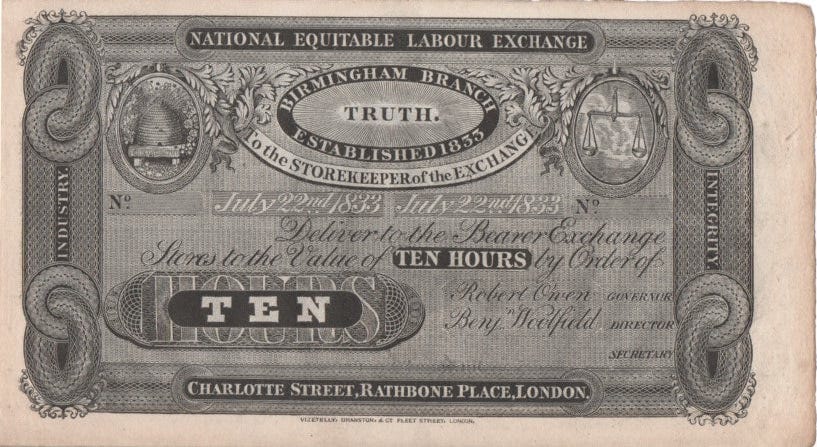
Democratic direction establishes the planning targets, the general labour allocations and first-order objectives for social development. With revived forms of popular assembly utilising referenda and agora, mass trials, selection by lot, it allows executive edict as it benefits the working population, and the rotation through political service will build the moral virtues needed for judgment by the population. Pro-labour parties would advocate access to public services and educational or experimental facilities via a common fund established through direct income deductions; income that people can forgo via national ballots, in popular votes to set the income tax rate.
The productive population can then directly address the specific issues of the day, set the agenda and declare a veto of past decisions. With this, we can predict industrial spending and electrification that favours human social reproduction and flexible power, and the growth of the stock which allows the steady growth and replacement of the population with labour-saving devices. Leisure and study time will increase, while also allowing the redeployment of labourers to other sectors if needed. Communal organisation becomes possible as contractual subordination is replaced by what is political or democratic secondment to particular industrial sectors. This loosens the pressures towards fixed or territorial domicile, particularly where living is met out through “industrial palaces” or communal accommodation like the longhouses past, and favours social kinship. The full realisation of such an economy can only come through the practical elimination of the antagonism between polis and chora, the creation of land armies of labour, the building of the proposed industrial palaces, communal dwelling for both rural and urban living, and country and seaside retreats for holidays. The principle issues of the economy then become international trade, in-kind calculation and the meeting of conscious political targets and objectives, and needs-based assessment for the population and polling of their living conditions, lifestyle, opportunities and progress.
Where the population is trained, armed and organised into militia where units elect their own commanders, with young men being conscripted, and voting on national mobilisation via referendum means the productive population, the soldiers and workers that are actually mobilised, that actually fight, get the full and equal say on war declarations. However, against reactionary forces, whether civil or external, the entire population can vote to mobilise against threats that would disturb the revolution, or for national liberation or international armed resistance. Thus, on the one hand exists perpetual preparation and deterrence, on the other hand, the active ability to mobilise and send expeditions. This only becomes possible with radical democracy, described by Aristotle, supported by Protagoras, and as advanced by Marx—the Revolutionary Dictatorship of the Proletariat.
“On the question of a militia, we should say: We are not in favor of a bourgeois militia; we are in favor only of a proletarian militia. Therefore, “not a penny, not a man”, not only for a standing army, but even for a bourgeois militia, even in countries like the United States, or Switzerland, Norway, etc. The more so that in the freest republican countries (e.g., Switzerland) we see that the militia is being increasingly Prussianized, particularly in 1907 and 1911, and prostituted by being used against strikers. We can demand popular election of officers, abolition of all military law, equal rights for foreign and native-born workers (a point particularly important for those imperialist states which, like Switzerland, are more and more blatantly exploiting larger numbers of foreign workers, while denying them all rights). Further, we can demand the right of every hundred, say, inhabitants of a given country to form voluntary military-training associations, with free election of instructors paid by the state, etc. Only under these conditions could the proletariat acquire military training for itself and not for its slaveowners; and the need for such training is imperatively dictated by the interests of the proletariat. The Russian revolution showed that every success of the revolutionary movement, even a partial success like the seizure of a certain city, a certain factory town, or winning over a certain section of the army, inevitably compels the victorious proletariat to carry out just such a programme.”
[Lenin, 1917]
This creates a counter-intuitive situation. The people who would fight, who are forced to meet out the sacrifice, would, for the first time, vote and consciously decide upon their own sacrifice. In these circumstances, the behaviours motivated by species and self-preservation would, in the long-term, reduce the pressures of war. This is accelerated where more modes of productions advance towards self-sustaining energy sources, such as nuclear fusion, and ecological farming techniques which would reduce the pressure for competition over natural resources. This is only possible where nations turn towards communal relations, removing the social fetters on the development of the productive forces, having tight controls on the movement of labour and means of production, and co-operation in international trade which is calculated on the basis of relative advantages between different countries.
“War, this monster of mutual slaughter among men, will be finally eliminated by the progress of human society, and in the not too distant future too. But there is only one way to eliminate it and that is to oppose war with war, to oppose counterrevolutionary war with revolutionary war, to oppose national counter-revolutionary war with national revolutionary war, and to oppose counter-revolutionary class war with revolutionary class war.... When human society advances to the point where classes and states are eliminated, there will be no more wars, counter-revolutionary or revolutionary, unjust or just; that will be the era of perpetual peace for mankind. Our study of the laws of revolutionary war springs from the desire to eliminate all wars. Herein, lies the distinction between us Communists and all the exploiting classes.”
[Mao, 1936]
Internally, as war is defeated, this is combined with the modern moral advances of universal suffrage. Women would find an increased representative share, and be able to advocate for socialised childcare, fertility protection, and female-led independent and international organisation which in turn increases the political equality and domestic equality between the sexes. The reduced dependency of children upon the atomic family income and private property, instead being met out by the economic community and social division of labour, would allow the full development of mutual love as the dominate relation between couples.
Justice against crime would be met out as non-professional, with citizens’ arrest and mass tribunals, composed of volunteers or randomly-selected members, deciding the sentencing and roles delegated amongst the tribunal bodies themselves. Eventually, this will reassert egalitarianism and make the state superfluous as property and land is common for the use of the entire economic community, made reality by physical mobility and rotation of labour and land armies between industry and agriculture. Where people rotate or move to work in different sectors, they would be accepted equally into that new community where housing is communally built and central-rental collection, not private ownership, is what protects the living space. Pater familias is effectively destroyed. Territorial domicile, as enforced by class relations, gives way to social kinship. Humans would operate more as a collective organism with conscious and intelligent decisions deciding the distribution of labour. They would also principally realise a hominid sexual nature that is matriarchal, which suits the selection of partners by women because they have the permanent oestrous state. Arguably, this would convey a long-term evolutionary advantage [Mogielnicki & Pearl 2020].
There is no reason to hide behind the fact that Communism predicts long-term anthropological and reproductive stability, not simply social goals.
References:
The Social Revolution (Vol II.) Karl Kautksy. 1902. Charles Kerr & Co., 1903.
Minutes of the Second Congress of the Communist International. Seventh Session July 30. 1920
Value, Prices, and Profit. Karl Marx. 1865. Value, Price and Profit. New York: International Co., Inc, 1969.
Materials Relating to the Revision of the Party Programme. VI Lenin 1917. Lenin Collected Works, Progress Publishers, 1964, Moscow, Volume 24, pages 455-480.
Politics (Book II). Aristotle. 350BC. Translation: B. Jowett. Oxford, Clarendon Press, 1885.
How the World Works: The Story of Human Labour From Prehistory to the Modern Day. Paul Cockshott 2019. Monthly Review Press.
The Military Programme of the Proletarian Revolution. VI Lenin 1916. Lenin’Collected Works, Progress Publishers, 1964, Moscow, Volume 23, pp. 77-87.
“Problems of Strategy in China’s Revolutionary War”. Mao Tse-Tung. 1936. Selected Works, Vol. I, pp. 182-83.
Hominid sexual nature. Mogielnicki & Pearl. Theory Biosci. 2020 Jun;139(2):191-207. doi: 10.1007/s12064-020-00312-8. Epub 2020 Mar 13.
Follow CYCLONE on social media: @force_cyclone.
Support CYCLONE on Patreon: https://www.patreon.com/force_cyclone
For submissions and enquiries, email: cyclone_force@protonmail.com