
The Dragon has Two Destinies
By Stephen Nuttall

In the first of two pieces Stephen Nuttall takes a sweeping look over radical Welsh history and its prospects for a revolutionary future.

As every schoolboy (and schoolgirl) used to know, the Norman conquest of 1066 was the last successful foreign invasion of Britain. And by 1072, William II of Normandy (later William I of England) had consolidated his control over the entirety of the English domain. After the period of Roman Britain (43-c.410) this was the island’s second experience of centralist authority and the legacy of the Norman hegemony has continued to the present day. Indeed, according to the “Norman Yoke” theory, popularised during the 17th-century English Civil War by radical groups like the Diggers, the roots of British ethnic conflict, social alienation, class struggle and colonialism can all be traced back to this period. (Interestingly, the City of London was established around 50 CE, seven years after the Roman invasion, and its constitution is rooted in the rights and privileges enjoyed by its citizens before the Norman period. Nevertheless, it was William the Conqueror who granted the citizens of London a royal charter in 1067, officially validating their time-honoured liberties. Ultimately, this process led to the founding of the Bank of England in 1694, arguably the catalyst for the development of the City as the original driving force of British capitalism and imperialism).
The Middle Ages in England were marked by civil war, cross-border war and intermittent rebellion. Between 1277 and 1283, Plantagenet monarch Edward I opted to decisively colonise Wales. Over time, in order to fully subdue the indigenous population, the occupiers built more castles per square mile than in any other country in the world. Following this, the 1284 Statute of Rhuddlan effectively resulted in the permanent takeover of the principality. Thus Cymru became Greater England’s first imperial possession. Scotland fared better in retaining its national independence by way of a series of military campaigns fought against the auld enemy. Despite the loss of Berwick-upon-Tweed in 1482, the Wars of Scottish Independence and the later Anglo-Scottish Wars guaranteed the sovereignty of the Scots until the creation of the Kingdom of Great Britain by the 1707 Acts of Union.
Throughout this period the feudal mode of production prevailed. The Peasants’ Revolt of 1381, often described as the most extreme and widespread insurrection in English history, signalled the beginning of the end for serfdom in England, with Elizabeth I freeing the last of the serfs in 1574. Bonded labour survived in Scotland until 1799, when coal miners previously kept in serfdom gained their emancipation. Even so, the majority of Scottish serfs had been freed prior to this date.
The English Revolution (1640–1660) was a classical revolution—a prolonged process rather than a singular event—that anticipated the trajectories of both the French (1789–1799) and Russian (1917–1921) Revolutions. It was defined by a volatile mix of religious strife, ideological warfare, and class struggle, culminating in total civil war and cycles of revolution and counter-revolution. Central to this protracted upheaval was Oliver Cromwell’s New Model Army, which served as the primary engine for transferring power from the traditional landed elite to a nascent ruling class. Ultimately, this shift established bourgeois parliamentary government, dismantled the remnants of British feudalism, and laid the foundations for the capitalist system that would eventually usher in the world’s first industrial revolution.
British imperialism, therefore, was rooted in the consolidation of the modern English state — itself forged through sustained territorial expansion, political turbulence, and revolution — and later strengthened by the incorporation of a rising Scottish bourgeoisie. While many historians date the emergence of the British Empire to the establishment of English colonies and commercial networks in the Americas during the fifteenth and sixteenth centuries, this perspective can obscure earlier phases of expansion. Long before transatlantic ventures, England’s most significant acquisitions were closer to home: the conquest and integration of Wales and the establishment of footholds in Ireland under the Norman and Plantagenet dynasties.
At its zenith, the British Empire was the biggest formal empire the world has ever known. Between the two World Wars of the twentieth century, it controlled 20.00% of humanity across 22.63% of the Earth’s total land mass. Enough has been written about the dominions on which, according to Scottish author John Wilson, the sun never set, to fill a dedicated library. But beyond the myths of British imperialism—the spreading of the gospel to the ends of the earth, the civilising of poor naked heathens and the nurturing of democracy—lies an awful truth. It is a tale of untold riches for the most powerful at the cost of the blood, sweat and tears, and, of course, toil of the masses, regardless of race, nationality, gender or age.
In many ways, the story of working class resistance to all of the above is equally stupendous. Although way beyond the scope of this article, it is a tale of epic proportions that anyone who considers themselves to be a Marxist-Leninist should really know inside out.
As regards the history of class struggle in Wales there are some notable events worthy of further investigation. These include:
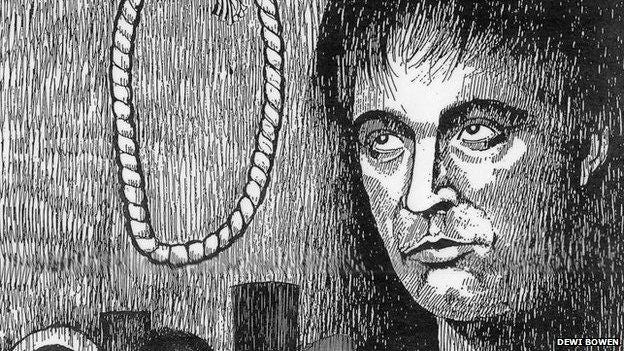
* The Merthyr Rising of 1831: A protest against wage-cutting and unemployment that marked the first occasion in Britain on which the red flag was flown as a symbol of workers’ power. It was the scene of the arrest of coal miner Dic Penderyn (Richard Lewis) on a charge of wounding a soldier with a bayonet. It is generally accepted that Penderyn was singled out because of his exemplary trade union activism, and although the evidence against him was flimsy he was unjustly sentenced to the gallows. In the 1870s, following a deathbed confession and other testimony, Dic Penderyn was absolved of any wrongdoing, but the bitterness that ensued in the wake of his execution merely served to strengthen the Trade Union movement and Chartism in South Wales and beyond.
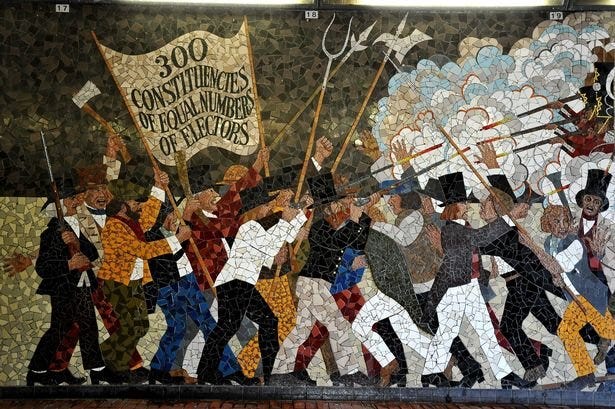
* The Newport Rising of 1839: An unsuccessful Chartist revolt and the last large-scale armed rebellion in Britain. It probably wasn’t a good idea to go up against regular soldiers, including the 45th (Nottinghamshire) Regiment of Foot, with home-made weapons, but there was no shortage of courage on the Chartist side. In fact, although the attempted insurrection proved a failure, other ultimately thwarted risings in support of the Newport contingent had been planned for Bradford, Sheffield, and London’s East End in the hope of provoking a Britain-wide upheaval.
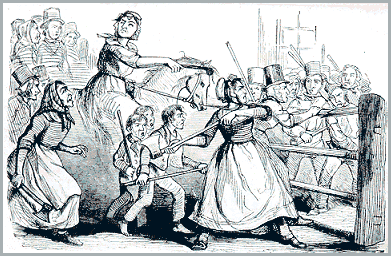
* The Rebecca Riots of 1839-1843: A series of protests in South and Mid Wales against unfair taxation. The rioters of Merched Beca or “Rebecca’s Daughters” (a biblical reference), usually male farmers and agricultural workers dressed as women, took their fight to landlords and toll-gates across the Welsh countryside.
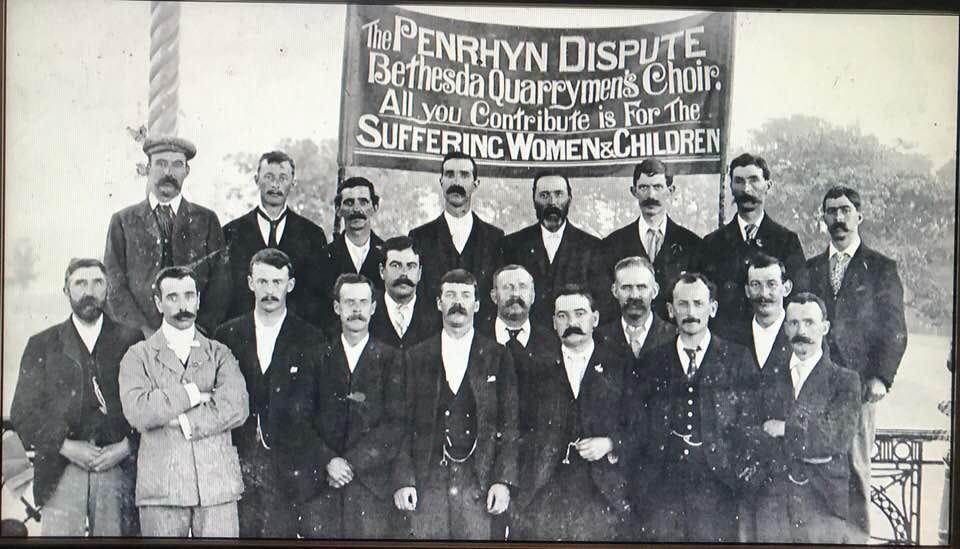
* The Great Penrhyn Strike of 1900: An extension of the class war to North Wales. The second strike at Penrhyn Slate Quarry, near Bethesda, lasted for three years, involved a walk-out of 2,000 workers in support of 800 victimised colleagues, and turned out to be the longest dispute in British industrial history. The strike dealt a blow to the Welsh slate industry, with orders down and more than a thousand fewer quarrymen being employed at Penrhyn by 1907.
The turn of the twentieth century also heralded a sea-change in the basic outlook of the most militant elements of the Welsh proletariat. Political reformism in Wales—a product of religious Nonconformity—envisioned a peaceful evolution towards socialism, but this concept was gradually supplanted by the Marxist idea of violent class struggle. In the South Wales Coalfield a section of the South Wales Miners Federation rank and file published the syndicalist manifesto The Miners’ Next Step. The young colliers involved had definitely had enough of Welsh cronyism and class-collaboration. The revolutionary strategy outlined in The Miners’ Next Step came to dominate socialist thinking within the coalmining industry for an entire period, extending up to and beyond the formation of the Communist Party of Great Britain in 1920. Shortly thereafter, during the interbellum between the century’s two world wars, Britain’s General Strike was defeated in May 1926. The failure of the nine-day conflict—which displayed a level of working-class solidarity and determination surpassing even that of the Chartist era—is often described as ignominious, owing to the Labour Party’s and Trades Union Congress’s bureaucratic capitulation to the class enemy.
Following the end of World War II in 1945, the ‘post-war boom’, a twenty-five year economic upswing, brought expansion and prosperity to Britain and other western countries. (The economies of East Asia would go through a similar pattern in the 1980s and 90s). In Britain, the boom lasted until the early 1970s, and then entered a crisis with the collapse of the Bretton Woods system in 1971. (At the time, the ending of the Bretton Woods agreements on monetary management, precipitated by the United States government’s unilateral termination of US dollar to gold convertibility, was pinpointed by Gerry Healy’s millenarian Workers’ Revolutionary Party as the beginning of a world revolution). Since this phase, capitalism has gone through a series of crises leading up to the dire global situation we all now face.
The fall-out from Bretton Woods included the 1972 miners’ strike and an oil crisis in 1973, which led to stagflation and a government-imposed state of emergency, the Three-Day Week, early the following year. With the advent of Thatcherism came the 1984–1985 miners’ strike and the Poll Tax Riots of 1990. The defeat of the miners was a major watershed in the history of British industrial relations leading to the overall decline of the trade union movement. Meanwhile, deep coal mining has ceased in the UK, making the number of active, traditional coal mining jobs in 2026 effectively zero.
Since the Margaret Thatcher years, the Labour Party has experienced a steady decline in its popularity. Given the party’s record of consistent betrayal of workers at key moments in the class struggle this should be of no surprise. Tony Blair’s ‘New Labour’ project of the mid-1990s, influenced by the spirit of Thatcherism, provided a temporary respite, but the waning of Labour’s fortunes continued when the marketing campaign wore thin. With this in mind it is easy to see why, in recent decades, other political parties have arisen to challenge Labour’s long held position of standard bearer of perceived progressive change. To date, these include the Green Party of England and Wales, the Scottish Green Party, Plaid Cymru, the Scottish National Party, and, latterly, both Reform UK and Your Party.
Contemporaneous with the ascent of the British Greens has been the rise of civic nationalism in Wales. Originally formed in 1925, by the Welsh poet and dramatist, Saunders Lewis, as a reactionary monarchist party (Plaid Genedlaethol Cymru or National Party of Wales), Plaid Cymru—The Party of Wales gradually moved to a centre-left position, firstly under the influence of Dr. D.J. (David James) Davies, who was in favour of workers’ control of the means of production, and then under the impact of the battle against the drowning of valleys and the battle for the preservation of the Welsh language.
Unlike their co-thinkers in Ireland, Welsh nationalists had largely eschewed violence as a means of struggle. However, the exploits of MAC (Mudiad Amddiffyn Cymru or Movement for the Defence of Wales) and the Free Wales Army (FWA) during the 1960s are noteworthy for the reason that these paramilitary groups simultaneously carried out a war against capitalist property and symbols of British imperialism. Possibly the most audacious of their acts of sabotage was MAC’s exploding of a transformer on the dam construction site of the Llyn Celyn reservoir in 1963; the prelude to a bombing campaign that lasted six years. The cause of this had been the planned forced flooding of Capel Celyn, a rural community in the Afon Tryweryn valley in North Wales. By way of an Act of Parliament, Liverpool City Council sought to deliberately submerge the village and other parts of the valley in order to supply Merseyside industries with water. The successful private bill via which the council had obtained the necessary authority in 1957 circumvented all popular opposition in Wales and occasioned widespread outrage. By the time the valley was under water in 1965, support for Plaid Cymru had grown and moves were afoot to usher in a then unspecified form of devolution. A year later, Gwynfor Evans won Plaid’s first Parliamentary seat in Carmarthen. Capel Celyn obviously played a part in his victory as did Labour’s perceived lack of concern for the small mining communities in the south of the country.
At this juncture, The Party of Wales went through changes. After 1945, younger members had tended to follow the path of the aforementioned Dr. D.J. Davies. Not unnaturally, Davies had always held a strong antipathy towards erstwhile leader Saunders Lewis. So it was therefore quite ironic that the ex-president’s last significant political act should help push Plaid further to the left. In February 1962, Lewis had delivered a dramatic BBC radio lecture entitled Tynged yr Iaith (The Fate of the Language). In his talk he predicted the extinction of the Welsh language unless radical means were used to defend it. As a result of the lecture, Cymdeithas yr Iaith Gymraeg (The Welsh Language Society) was launched at a Plaid Cymru summer school in August of that year. The Society’s first public remonstrance for official status for the language was held in Aberystwyth in February 1963 and took the form of non-violent direct action. Around seventy members and supporters staged a sit-down protest blocking road traffic for half an hour on the Trefechan Bridge. Since then over a thousand activists have appeared before the courts for their involvement in various campaigns with many of them receiving prison sentences.
Today, the eclipse of groups such as MAC and the FWA by the likes of YesCymru—a non-party campaign for an independent Wales—reflects less a simple retreat than a strategic and cultural shift in Welsh nationalism. Whereas 1960s militancy arose in a context of limited constitutional recognition and symbolic grievances, the advent of devolution, the establishment of the Senedd, and the growth of electoral nationalism through Plaid Cymru created viable democratic channels for advancing self-government. Contemporary independence activism therefore operates within a reformist, social-democratic framework that prioritises mass participation, electoral legitimacy, and constitutional change over confrontation.
Plaid emerged in the 20th century as a cultural-national movement, and during the 1960s it carried a distinct sense of urgency and activism. The party functioned largely as a protest movement. Campaigns for the Welsh language and political recognition were driven by grassroots activism, civil disobedience, and cultural revival energy. In its present form, as an established parliamentary party operating in the Senedd and Westminster, it must balance ideals with legislative negotiation and electoral strategy. This has led to a gradualist approach which feels less passionate than it did in that earlier era. Before devolution, Plaid could frame itself as the voice of an unrepresented nation. After the creation of the Senedd in 1999, Welsh political autonomy became institutionalised. Since then Welsh-language education has expanded, Welsh has official status, and Welsh media (like S4C) now exists. Because some core cultural goals have been partially achieved, the existential edge that once energised supporters has softened. With representation now embedded in governance, Plaid moved from campaigning for a parliament to operating within one. That change often reduces radical tone and increases policy pragmatism.
The 1960s were a decade of global political tumult. Youth movements, anti-establishment energy, and civil rights struggles created a climate in which nationalist activism felt urgent and romantic. Modern politics is more managerial and media-driven. Activism still exists, but it often manifests differently—online, issue-based, and less tied to cultural nationalism. To win seats beyond its traditional Welsh-speaking heartlands, Plaid must appeal to urban, diverse, and economically varied communities. That can require moderating rhetoric and aspirations, which may be interpreted by long-time supporters as a loss of ideological fire.
Gone are the heady days of Gwynfor Evans, the FWA’s Julian Cayo-Evans and Dennis Coslett, and John Barnard Jenkins, leader of MAC. Today, Welsh independence politics is dominated by career-minded figures whose “little Britain” vision includes joining supranational bodies such as the EU, as well as intergovernmental organisations like NATO, the OECD, and the WTO. (A similar process has occurred in Scotland, where 1970s firebrands including Margo MacDonald and Jimmy Reid have largely been superseded.)
Perhaps the most telling indictment of the liberal nationalist movement in Wales is its failure to educate the public—both about Wales’s rich history of class struggle and about the complexities of contemporary geopolitics.
Take a drive through Cymru—even around the Isle of Anglesey, which is referred to as the “Mother of Wales”—and you will see the shameful sight of Ukrainian flags flying in profusion alongside the banners of Wales: Y Ddraig Goch, St David’s Cross, and even the arms of Glyndŵr, all adjacent to the garish raasclaat of an imperialist proxy state, the bloodstained puta of all Europe.
For those with eyes to see and ears to hear, the association is obvious. In the stirring Welsh-language folk song “Hyma o Hyd” (Welsh for ‘still here’), written by veteran nationalist troubadour Dafydd Iwan, the lyrics indicate that—like a wind blowing from the east—the enemy is England. The parallel between the relationship of Wales and England and that of Ukraine and Russia is therefore crystal clear. Yet, when expedient, the usual social-democratic suspects—the servile floor-lickers mentioned in the song—and their sheep-like followers have no problem lining up with British imperialism against the Russian Federation.
With a mindset so contradictory and unprincipled, it’s no wonder confusion abounds. Indeed, if it weren’t so tragic, it would be funny — and painfully so.
Follow CYCLONE on social media: @force_cyclone.
Support CYCLONE on Patreon: https://www.patreon.com/force_cyclone
For submissions and enquiries, email: cyclone_force@protonmail.com