
NATO, the USSR, and the Logic of Capitalist Encirclement
By Stephen Nuttall

In his debut piece, Stephen Nuttall looks at the foundation of NATO, pointing out that liberal arguments about the defensive rationale of this military alliance fall away with just a cursory look at its history.
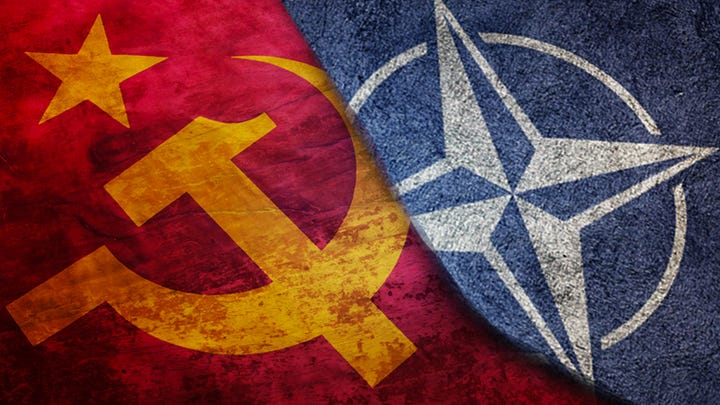
In 1954, at the height of the Cold War, the Soviet Union made a move that immediately disrupts the conventional Western narrative about NATO: it expressed a willingness to join. The proposal followed the Berlin Conference, where Soviet Foreign Minister Vyacheslav Molotov advanced an alternative vision of pan-European collective security. If NATO were genuinely defensive, the argument went, why should the USSR be excluded?
The Western powers rejected the proposal outright.
Officially, the refusal rested on the claim that NATO was a defensive alliance built upon shared political principles incompatible with Soviet governance. Yet the episode raises a more fundamental question: if NATO was purely defensive, why not dissolve the bloc logic altogether through mutual integration? Why preserve a structure premised on division?
To answer this, one must move beyond diplomatic formalities and examine material interests.
The North Atlantic Treaty, signed on 4 April 1949, enshrined collective defence in Article 5: an attack on one member would be treated as an attack on all. This clause institutionalised military solidarity across the North Atlantic capitalist powers. But solidarity against whom?
From a Marxist standpoint, NATO was never an abstract defensive mechanism. It was a military consolidation of the dominant capitalist states in response to the emergence of a rival social system. The alliance formalised what had already existed in practice: a coordinated front to contain, weaken, and ultimately overturn socialist development.
The Soviet suggestion of membership therefore presented a contradiction. Incorporating the USSR would have neutralised the alliance’s central organising principle. NATO’s purpose was not pan-European peace; it was strategic containment.
The collapse of the Soviet Union did not dissolve NATO. On the contrary, the alliance expanded eastward, integrating former Warsaw Pact states and moving steadily toward Russia’s borders. If the alliance had been created solely to counter a vanished threat, its continuation would be difficult to explain.
Again from a Marxist perspective, however, the continuity is obvious.
Capitalism is not merely a system of markets; it is a system driven by accumulation. As analysed by Karl Marx and Friedrich Engels, the tendency of the rate of profit to fall generates recurring crises. Overaccumulation, stagnation, and intensified competition compel capitalist states to seek external solutions: new markets, cheaper labour, strategic resources, and geopolitical dominance.
Military alliances become instruments of this expansion.
In this light, NATO’s posture toward the Russian Federation, the People’s Republic of China, the Democratic People’s Republic of Korea, and Iran is not reducible to abstract “security concerns.” These states represent obstacles—geopolitical, economic, or ideological—to unrestrained Western capital penetration. Likewise, persistent pressure on countries such as Cuba and Venezuela reflects resistance to incorporation into neoliberal circuits of capital.
The Soviet attempt to join NATO in 1954 was not naïve. Nor was it likely expected to succeed. It exposed a contradiction: an alliance claiming defensive universality could not admit the very state it defined as adversary. The rejection clarified the alliance’s real historical function.
NATO was, and remains, the armed expression of a specific economic order.
Its expansion is not an accident of diplomacy but a structural feature of capitalist geopolitics. As profit rates compress and systemic instability deepens, the pressure for strategic control intensifies. Military encirclement, sanctions, hybrid warfare, and regime destabilisation are not deviations from the liberal order—they are mechanisms for its preservation.
The Cold War may have ended in formal terms, but the material forces that produced it persist. As long as global capitalism depends upon accumulation, competition, and unequal exchange, its leading states will organise militarily to secure advantage. Alliances such as NATO function not merely as shields, but as enforcers of a world system.
From this point of view, the events of 1954 were not a diplomatic curiosity. They were an early demonstration of a deeper truth: collective defence within the capitalist core necessitates collective pressure outward. The bloc was never meant to dissolve antagonism; it was built to manage and project it.
History, viewed through this lens, appears less as a series of misunderstandings and more as the unfolding logic of a system struggling to sustain itself.
🌀 Follow CYCLONE on social media: @force_cyclone.
🌀 Support CYCLONE on Patreon: https://www.patreon.com/force_cyclone
🌀 For submissions and enquiries, email: cyclone_force@protonmail.com
For the millionth time: there is no such thing as "free trade" without gunboats. When Lenin said that money is not backed by gold, mining bitcoin or whatever but by "organized body of armed man" he was mainly talking of national police at your door explaining what is money but it works just the same at global level with NATO